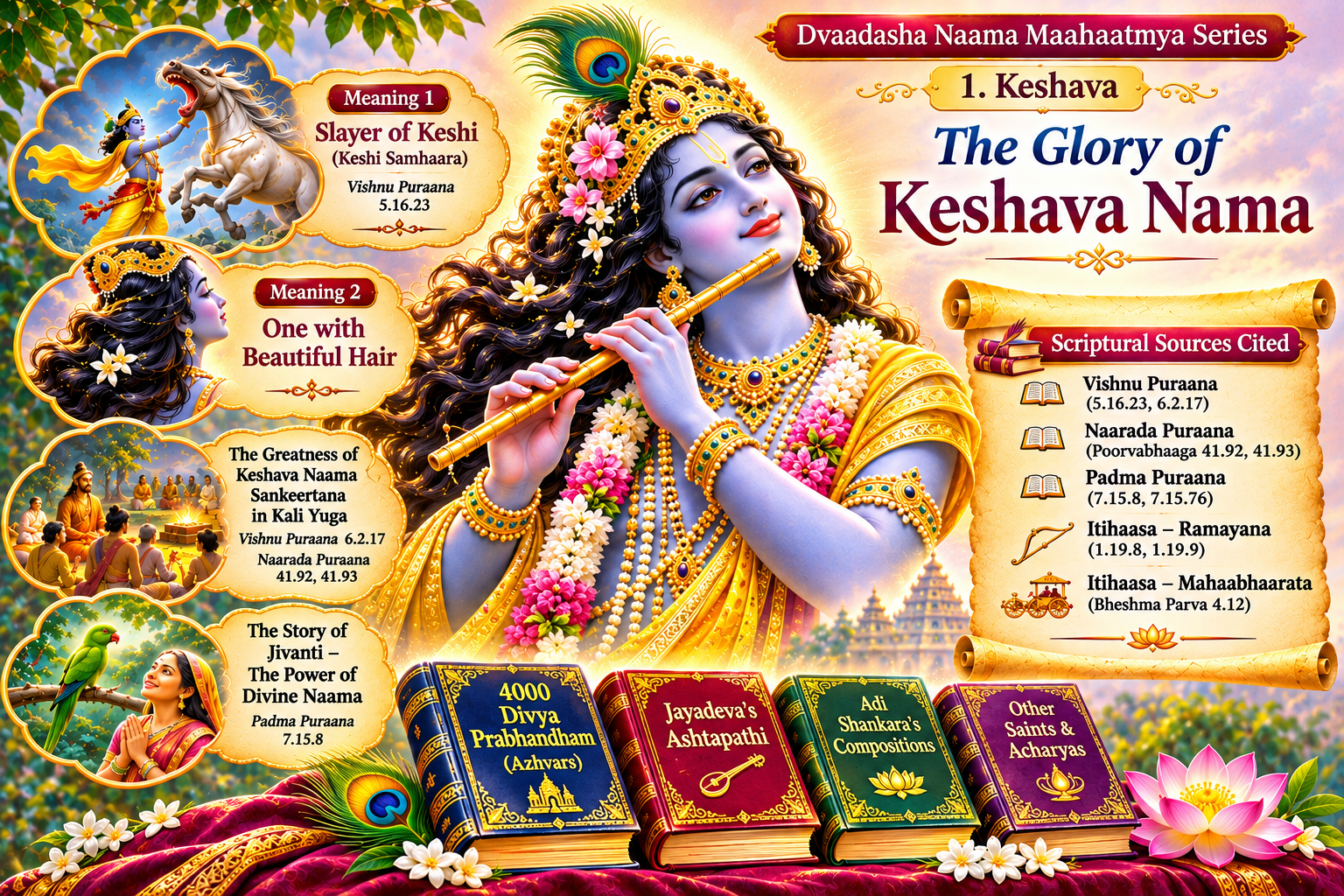
KESHAVA
This section of the newsletter describes the importance / significance of the name Keshava of Bhagwan which is the first of the 12 important names that HE has.
Among the innumerable names of Bhagavaan Shree Krishna, the name Keshava holds a special place in the sacred literature of Sanaatana Dharma. The Puraanas extol the power of chanting this divine name, particularly in Kali Yuga. The Mahaabhaarata presents Keshava as the Supreme Lord worthy of praise and worship, while Aaḻvaars, Aacaaryas and other great devotees have celebrated the name in their devotional compositions.
The scriptural passages gathered here reveal several dimensions of Keshava Naama: its association with Bhagavaan’s divine deeds, its extraordinary spiritual potency, its place in the Itihaasas, and the intimate love with which devotees call upon the Lord.
1. FROM THE PURANAS
Vishnu Puraana
The Vishnu Puraana explains one of the meanings associated with the divine name Keshava. After Bhagavaan slays the asura Keshi, He is celebrated throughout the world by that name:
यस्मात्त्वयैष दुष्टात्मा हतः के शी जनार्दन।
तस्मात्के शवनाम्ना त्वं लोके ख्यातो भविष्यसि॥
Vishnu Purana 5.16.23
Transliteration
yasmaat tvayaisha dushtaatmaa hatah keshi janaardana |
tasmaat keshavanaamnaa tvam loke khyaato bhavishyasi ||
Meaning
“Because you have slain the wicked Keshi, O Janardana, you shall become renowned in the world by the name Keshava.”
The Vishnu Puraana further declares that the spiritual attainment gained through the principal disciplines of the earlier Yugas can be attained in Kali Yuga by singing the name of Keshava:
ध्यायन् कृ ते यजन् यज्ञैस्त्रेतायां द्वापरेऽर्चयन्।
यदाप्नोति तदाप्नोति कलौ सङ् कीर्त्य के शवम्॥
Vishnu Purana 6.2.17
Transliteration
Dhyaayan krite yajan yajnyais tretaayaam dvaaparearcayan,
yad aapnoti tad aapnoti kalau sangkeertya Keshavam.
Meaning
Whatever spiritual attainment is obtained through meditation in Kruta Yuga, through the performance of Yagnas in Treta Yuga and through worship in Dvapara Yuga can be obtained in Kali Yuga by singing the divine name of KESHAVA.
The scriptures prescribe different spiritual disciplines for different Yugas, taking into account the capacities and circumstances of human beings. In Kruta Yuga, prolonged meditation was the principal means of spiritual attainment. In Treta Yuga, elaborate Vedic fire-sacrifices assumed prominence, while in Dvapara Yuga the worship of Bhagavaan was especially emphasized. This verse declares that the spiritual fruits associated with those disciplines are accessible in Kali Yuga through Keshava Sangkeertana. It therefore establishes the extraordinary greatness attributed to the chanting of this divine name.
Narada Purana
The Naarada Puraana repeats the verse on the greatness of singing Keshava’s name, reinforcing the importance of Naama-keertana in Kali Yuga:
ध्यायन् कृ ते यजन् यज्ञैस्त्रेतायां द्वापरेऽर्चयन्।
यदाप्नोति तदाप्नोति कलौ सङ् कीर्त्य केशवम्॥
Narada Purana, Poorvabhaga 41.92
The very next verse declares:
अहोरात्रं हरेर्नाम कीर्तयन्ति च ये नराः।
कुर्वन्ति हरिपूजां वा न कलिर्बाधते च तान्॥
Naarada Puraana, Poorvabhaga 41.93
Those who chant Hari’s divine name day and night, or engage in the worship of Lord Hari, are not afflicted by the evils of Kali Yuga. Together, these verses emphasize the importance of constant remembrance, worship and Naama-keertana in the present age.
Padma Purana
The Padma Purana introduces a narration that explains the glory of the name of the great Lord Keshava:
नामप्रभावं विप्रर्षे केशवस्य महात्मनः ।
ब्रवीम्यहं समासेन सेतिहासं निशामय ॥ ८ ॥
Padma Purana 7.15.8
Kriyaayogasaara Khanda 7.15.8
Transliteration
Naamaprabhaavam viprarshe keshavasya mahaatmanah,
braveemyaham samaasena setihaasam nishaamaya.
Meaning
“O foremost among sages, I shall briefly explain the glory of the name of the great Lord Keshava, together with its accompanying narrative. Listen attentively.”
The sages then discuss the story of Jivanti, who taught her pet parrot to chant the name ‘Rama’. At the end of her life, the parrot repeated this divine name. By hearing it, Jivanti attained the highest goal of human life—liberation.
In the same Purana and chapter, verse 76 lists several important divine names of Bhagavaan, including Keshava. Yama Dharmaraaja declares:
गोविन्द के शव हरे जगदीश विष्णो नारायणप्रणतवत्सलमाधवेति ।
भक्त्या वदन्ति पुरुषाः सततं क्षितौ ये दण्ड्या न ते मम भटा अतिपापिनोऽपि ॥
Padma Purana 7.15.76
Transliteration
Govinda Keshava Hare Jagadeesha Vishno Naaraayanapranatavatsala Maadhaveti,
bhaktyaa vadanti purushaah satatam kshitau ye dandyaa na te mama bhataa atipaapino ’pi
Meaning
“Those people on earth who constantly utter with devotion the names ‘Govinda, Keshava, Hari, Lord of the universe, Vishnu, Narayana, the compassionate protector of those who surrender, and Madhava’—even if they have committed grave sins—are not to be punished by my servants.” So declares Yama Dharmaraaja, the lord of death.
This passage places Keshava among the divine names whose devoted remembrance is praised by Yama Dharmaraja himself.
2. FROM THE ITIHASAS
The Puranas glorify Keshava Naama, and the Itihasas offer further insight into the name. Keshava is also understood as ‘the Lord with beautiful hair’. The Raamaayana contains several descriptions of Shree Raama’s dark, curly side-locks, referred to as kaaka-paksha.
RAMAYANA
When Sage Vishvamitra visits King Dasharatha’s court and asks that Rama accompany him to protect his yajnya, he describes the young prince:
स्वपुत्रं राजशार्दूल रामं सत्यपराक्रमम् ।
काकपक्षधरं शूरं ज्येष्ठं मे दातुमर्हसि ॥ १-१९-८ ॥
शक्तो ह्येष मया गुप्तो दिव्येन स्वेन तेजसा ।
राक्षसा ये विकर्तारस्तेषामपि विनाशने ॥ १-१९-९ ॥
svaputram raajashaardoola raamam satyaparaakramam |
kaakapakshadharam shooram jyeshtham me daatum arhasi || (Srimad Valmiki Ramayana Bala Kandam 1.19.8)
shakto hyesha mayaa gupto divyena svena tejasaa |
raakshasaa ye vikartaaraas teshaam api vinaashane || (Srimad Valmiki Ramayana Bala Kandam 1.19.9)
Meaning
“O tiger among kings, you should entrust to me your eldest son, Rama, the brave one of unfailing valor, whose hair-locks resemble the wings of crows. Protected by me and endowed with his own divine radiance, he is capable of destroying the demons who obstruct my sacrifice.” These are the words of Sage Vishvamitra to King Dasharatha.
The sages
After the protection of the sage’s fire sacrifice, Rama and Lakshmana follow Vishvamitra. The poet again draws attention to Rama’s distinctive side-locks:
विश्वामित्रो ययावग्रे ततो रामो महायशाः ।
काकपक्षधरो धन्वी तं च सौमित्रिरन्वगात् ॥ १-२२-६ ॥
Srimad Valmiki Ramayana Bala Kandam 1.22.6
vishvaamitro yayaav agre tato raamo mahaayashaah |
kaakapakshadharo dhanvee tam ca saumitrir anvagaat ||
Meaning
“Vishvamitra walked ahead. Then the illustrious Rama, carrying his bow and wearing dark side-locks resembling crow’s wings, followed him; Lakshmana followed Raama.”
King Janaka
Another striking description occurs when King Janaka sees Rama and Lakshmana at the sacrificial enclosure in Mithila. He is impressed by their appearance and asks Sage Vishvamitra about them:
परस्परस्य सदृशौ प्रमाणेङ्गितचेष्टितैः ।
काकपक्षधरौ वीरौ श्रोतुमिच्छामि तत्त्वतः ॥ १-५०-२१ ॥
Srimad Valmiki Ramayana Bala Kandam 1.50.21
parasparasya sadrishau pramaanenggitaceshtitaih |
kaakapakshadharau veerau shrotum icchaami tattvatah ||
Meaning
“They resemble each other in stature, gestures, and movements. These two heroic princes wear dark side-locks. I wish to know the truth about them.”
King Janaka notices their resemblance, youthful appearance and kaaka-paksha hairstyle, and asks the sage to explain who they are. These descriptions show how the beauty of Bhagavaan’s dark side-locks is noticed not only by kings but also by sages. The source article draws attention to the fact that even those renowned for wisdom and self-control are captivated by the beauty of the Lord.
MAHABHARATA
The Mahabharata contains several references that directly glorify Keshava. The following passages highlight the name in different contexts.
Bhishma Parva
एष ते विस्तरस्तात संक्षेपश्च प्रकीर्तितः ।
के शवस्य यथातत्त्वं सुप्रीतो भज के शवम् ॥ १२ ॥
Bhishma Parva, Chapter 69, Verse 12
Esha te vistaras taata sangkshepash ca prakeertitah,
Keshavasya yathaatattvam supreeto bhaja Keshavam.
“Dear one, the true nature of Keshava has been described to you both in detail and in brief. With a joyful heart, devote yourself to Keshava.”
The verse goes beyond using Keshava merely as a form of address. Having described His true nature, it explicitly encourages the listener to devote himself to Keshava.
Shanti Parva
ते स्तुवन्तश्च विप्राग्र्याः के शवं पुरुषोत्तमम् ।
भीष्मं च शनकैः सर्वे प्रशशंसुः पुनः पुनः ॥ १०४ ॥
Shanthi Parva, Chapter 47, Verse 104
Te stuvantash ca vipraagryaah Keshavam Purushottamam,
BhIshmam ca shanakaih sarve prashashamsuh punah punah.
Meaning
“Those foremost among the brahmanas praised Keshava, the Supreme Person, and repeatedly commended Bheeshma.”
Here, Keshava is explicitly praised as Purushottama—the Supreme Person.
Naaraayaneeya
A particularly remarkable passage occurs in the Naaraayaneeya section of the Shaanti Parva. In this account, Bhagavaan Himself speaks to Arjuna about the power of the name Keshava:
वेदानवाप्य चतुरः साङ्गोपाङ्गान्सनातनान्। प्रयोजयामास तदा नाम गुह्यमिदं मम॥
आनुपूर्व्येण विधिना के शवेति पुनः पुनः। स चक्षुष्मान्समभवद्गौतमश्चाभवत्पुनः॥
एवं हि वरदं नाम के शवेति ममार्जुन। देवानामथ सर्वेषामृषीणां च महात्मनाम्॥
Shanti Parva – Narayaniya – CRITICAL EDITION 12.328.49–51
This passage describes the sage Deerghatamas, who had become blind as a consequence of a curse. Having acquired the four eternal Vedas together with their subsidiary branches, he employed Bhagavaan’s secret divine name in the prescribed manner. By repeatedly uttering “Keshava, Keshava”, he regained his eyesight and became Gautama again.
The words केशवेति पुनः पुनः — Keshaveti Punah Punah are especially significant: they explicitly describe the repeated utterance of the name Keshava. Bhagavaan then declares:
एवं हि वरदं नाम के शवेति ममार्जुन।
“O Arjuna, My name Keshava is indeed a bestower of boons.”
Unlike passages that simply address Bhagavaan as Keshava, this account directly speaks of the power of the name itself. The verse numbering differs among editions: this passage appears in Chapter 328 of the Mahaabhaarata Critical Edition and Chapter 350 in another widely circulated Sanskrit numbering.
Anushaasana Parva
In the Anushaasana Parva, Yudhishthira approaches , who lies upon his bed of arrows, and asks him about the Supreme Lord, the highest refuge and the means of attaining the greatest auspiciousness. In response, Bhishma reveals the thousand divine names of Bhagavan in the celebrated Vishnu Sahasranama.
At the conclusion of the thousand names, Bhishma declares:
इतीदं कीर्तनीयस्य के शवस्य महात्मनः।
नाम्नां सहस्रं दिव्यानामशेषेण प्रकीर्तितम्॥
“Thus have been proclaimed in their entirety the thousand divine names of the glorious Keshava, who is worthy of being praised and glorified.”
The expression कीर्तनीयस्य केशवस्य — Keertaniyasya Keshavasya deserves special attention. Bheeshma describes Keshava as Keertaneeya—the One who is worthy of being glorified. Bhagavaan is endowed with infinite auspicious qualities; His divine forms, wonderful deeds, compassion towards devotees and innumerable sacred names are all worthy of constant remembrance and praise. The thousand names of Vishnu are therefore presented as the divine names of Keshava Himself.
Bhishma immediately proceeds to explain the fruit of hearing and reciting these names:
य इदं शृणुयान्नित्यं यश्चापि परिकीर्तयेत्।
नाशुभं प्राप्नुयात्किञ्चित्सोऽमुत्रेह च मानवः॥
One who regularly listens to or recites these divine names does not encounter inauspiciousness, either in this world or in the next. The Mahabharata thus glorifies both the Lord and the act of singing His divine names.
3. FROM THE DEVOTIONAL COMPOSITIONS
Sri Jayadeva’s Gita Govinda
A Radha-Madhava vivaaha is incomplete without the singing of the Ashtapadis of Shree Jayadeva Swami. In the very first Ashtapadi, Shree Jayadeva lists the ten avataaras, or incarnations, of Bhagavaan and explicitly identifies each as Keshava.
The ten avataaras listed are Meena (fish), Kacchapa (turtle), Shookara (Varaaha or wild boar), Narasimha, Parashuraama, Raama, Balaraama, Krishna, Buddha and Kalki. Each Ashtapadi has eight verses, except the first, which has ten verses describing the incarnations. The concluding line of each verse reiterates that the incarnation is none other than Lord Keshava.
के शव धृतमीनशरीर जय जगदीश हरे ॥ १॥
It is particularly significant that Jayadeva invokes the name Keshava while praising the Lord’s various incarnations. Whether Bhagavan appears as Matsya, Koorma, Varaaha, Narasimha, Vaamana or Raama, Jayadeva glorifies Him through the same divine name—Keshava. The name thus celebrates the unity of the Supreme Lord manifesting in His various avataras.
Naalaayira Divya Prabandham
NAMMAZHVAR IN THIRUVAIMOZHI 10.2.1
The Azhvars have beautifully glorified the divine name Keshava (கேசவா). Among their compositions, Nammazhvar’s Tiruvaaymozhi 10.2.1 is especially significant because it declares that uttering “Keshava” removes all suffering and keeps the messengers of Yama away. The following four references illustrate the many ways in which the Azhvars celebrate this name.
கெடும் இடர் ஆய எல்லாம் கேசவா என்ன நாளும் கொடுவினை செய்யும்
கூற்றின் தமர்களும் குறுககில்லார் விடமுடை அரவில் பள்ளி விரும்பினான்
சுரும்பலற்றும் தடமுடை வயல் அனந்தபுரநகர் புகுதும் இன்றே.
English meaning
All suffering and afflictions disappear when one utters the divine name “Kesava”. Even the messengers of Yama, who inflict punishments for sinful deeds, will not approach such a devotee. Let us therefore proceed today to the sacred city of Anantapuram, surrounded by fertile fields where bees hum, and where the Lord lovingly reclines upon the serpent Adisesha.
The opening phrase declares that all suffering disappears upon uttering Kesava. Namaazhvar does not prescribe a complicated spiritual discipline here; he extols the power of uttering one divine name.
AANDAL IN THIRUPAVAI 7
நாயகப் பெண்பிள்ளாய்! நாராயணன் மூர்த்தி கேசவனைப் பாடவும் நீ
கேட்டே கிடத்தியோ? தேசமுடையாய்! திறவேலோர் எம்பாவாய்.
English meaning
O noble maiden! Even as we sing the glories of Keshava, the very embodiment of Narayana, are you still lying asleep, listening without joining us? O radiant one, open the door!
The young Gopis awaken their companion not merely with the sounds of the morning, but through the singing of Bhagavaan’s divine name. Keshava Naama is thus presented as a means of awakening the devotee to Bhagavat-anubhava—the experience of the Lord.
AANDAL IN THIRUPAVAI 30
வங்கக் கடல் கடைந்த மாதவனைக் கேசவனைத் திங்கள் திருமுகத்துச்
சேயிழையார் சென்றிறைஞ்சி அங்கப் பறைகொண்ட ஆற்றை, அணி
புதுவைப் பைங்கமலத் தண்தெரியல் பட்டர்பிரான் கோதை சொன்ன சங்கத்
தமிழ்மாலை முப்பதும் தப்பாமே இங்கிப் பரிசுரைப்பார், ஈரிரண்டு
மால்வரைத்தோள் செங்கண் திருமுகத்துச் செல்வத் திருமாலால் எங்கும்
திருவருள்பெற்று இன்புறுவர் எம்பாவாய்.
English meaning
The beautiful young maidens worshipped Maadhava, Keshava, the Lord who churned the ocean, and received the fruit of their observance. Godha, the daughter of Periyazhvar of Srivilliputhur, has composed these thirty Tamil verses describing their devotion. Those who faithfully recite all thirty verses will receive the divine grace of Lord Narayana and rejoice in His blessings.
PERIAAZHVAR IN THIRUMOZHI 2.3.1
பேய்ப்பால் முலையுண்ட பித்தனே கேசவ நம்பீ உன்னைக் காது குத்த
ஆய்ப்பாலர் பெண்டுகள் எல்லாரும் வந்தார் அடைக்காய் திருத்தி நான்
வைத்தேன்.
English meaning
O wondrous child who drank the milk of the demoness Putana! O Keshava, O perfect Lord! All the cowherd women have assembled for the ceremony of piercing Your ears. I have prepared the betel leaves and areca nuts. Come, my child!
Here Periyaaḻvaar assumes the loving role of Yashodaa and addresses the Supreme Lord Keshava as her little child. Keshava is not invoked through majestic descriptions of divine supremacy, but through a mother’s tender affection. This Pasuram begins Peiyaazhvar’s beautiful sequence celebrating the twelve divine names of Bhagavaan, from Keshava to Daamodara. It reveals another dimension of Keshava Nama: the sweetness and intimacy of calling out to Bhagavaan with love.
KULASEKARAAZHVAR IN MUKUNDAMALA Verse 16
जिह्वे कीर्तय के शवं मुररिपुं चेतो भज श्रीधरं पाणिद्वन्द्व समर्चयाच्युतकथाः श्रोत्रद्वय त्वं शृणु। कृ ष्णं लोकय
लोचनद्वय हरेर्गच्छाङ् घ्रियुग्मालयं जिघ्र घ्राण मुकु न्दपादतुलसीं मूर्धन्नमाधोक्षजम्॥
Meaning
O Tongue! Glorify Keshava, the destroyer of Mura!
O mind! Worship Sridhara.
O hands! Perform His worship.
O ears! Listen to the stories of Acyuta.
O eyes! Behold Krishna.
O feet! Proceed towards the abode of Hari’s lotus feet.
O nose! Smell the Tulasi offered at Mukunda’s feet.
O head! Bow down to Adhokshaja.
Kulasekara Aazhvar directs every sense organ towards Bhagavaan, but begins with the tongue and the keertana of Keshava Nama. The verse presents the chanting of the Lord’s name as the first among the devotional acts assigned to the senses.
Adi Shankara in Achyuthashtakam- Verse 1
अच्युतं केशवं रामनारायणं कृष्णदामोदरं वासुदेवं हरिम्।
श्रीधरं माधवं गोपिकावल्लभं जानकीनायकं रामचन्द्रं भजे॥
Meaning
I worship Acyuta, Keshava, Rama, Narayana, KRishna, Dhamodara, Vasudeva, Hari, Sridhara, Madhava, Gopika Vallabha, and Ramachandra, the Lord of Janaki.
Significance
This is a beautiful example of Nama-stuti, in which the Sri Adi Shankara worships Bhagavaan by reciting His different divine names. Keshava occupies a prominent place immediately after Acyuta. The concluding phalashruti of the stotra declares that one who recites it daily with love and longing receives the grace of Hari, who becomes responsive to the devotee’s love.
HH Maharanyam Sri Sri Muralidhara Swamiji- in Madhuragitam
HH Maharanyam Sri Sri Muralidhara Swamiji has composed innumerable keertans highlighting Naama-prabhaavam—the glory and power of the divine name. In one such keertana, titled “Rama Rama Endru Sonnal”, he refers to several names of Bhagavaan and indicates the effects of chanting those names.
The relevant line is:
கேசவ கேசவ என்றால் ஆசை போகுமே
வாமன வாமன என்றால் பொறாமை போகுமே
This means that the constant repetition of ‘Keshava’ Nama will get rid of desires and constant repetition of the name ‘Vamana’ will get rid of jealousy.
4. EVERLASTING GLORY OF KESHAVA NAMA
From the Puraanas and the Itihaasas to the Divya Prabandham and the compositions of great saints and Acharyas, the name Keshava has been celebrated for its immeasurable glory. It recalls Bhagavaan’s divine deeds and supreme nature, while inviting us to approach Him through loving remembrance and nama-sankirtana. Whether chanted in devotion, sung in praise or remembered with love, may Keshava Nama ever remain on our tongues and in our hearts, purify our minds, and lead us towards His divine grace.